
Seoul Viosys Eyes the $60 Billion AI Data Center Optical Communication Market with Opto Semiconductors
Joint Development Talks with Global Optical Communications companies

Expanding Partnerships to Provide Total Transceiver Solution
1,800 Patents Secured for High-Performance Optical Communications
SEOUL, South Korea–(BUSINESS WIRE)–#AIDataCenter—Seoul Viosys (KOSDAQ: 092190), a company specializing in opto-semiconductor devices, is accelerating its entry into the next-generation photonics market supported by its proprietary “No-wire” and “No-package” fundamental patents—essential technologies for micrometer (μm)-scale miniaturization of opto-semiconductors—as well as its competitiveness in VCSEL technology.
As the rapid expansion of AI drives a paradigm shift in data centers from copper-based to optical-based architectures, the company is strengthening its position through the acquisition of a VCSEL company for short-range communications five years ago and the completion of 100G (25G×4) class technology. Furthermore, Seoul Viosys is expanding its business model beyond component supply into a total transceiver solution provider for data interconnects.
Seoul Viosys is currently in discussions with two global leaders in data interconnects (optical communications) on joint technology development, as well as potential joint ventures or OEM manufacturing. The company is also exploring expanded collaboration with additional partners in the United States and Japan. Rather than simply supplying individual components, Seoul Viosys is securing a network of strategic partners to establish its position as a total-solution provider in the data interconnect transceiver market, spanning design, devices, drivers, and modules. Industry observers note that as the optical communications market shifts toward high-speed, low-power, and highly integrated architectures, building a partner ecosystem that connects technology, manufacturing, and applications will be critical, as it is increasingly difficult for any single company to respond alone.
First, Seoul Viosys’ position is underpinned by its patented opto-semiconductor device technologies. Conventional copper interconnects are approaching their physical limits in supporting the ultra-high-capacity, high-speed data transmission required by AI-driven environments. In contrast, Micro LED–based photonic technology enables efficient, high-speed transmission of large volumes of data, making it well-suited for high-density infrastructure such as AI data centers. This low-power, ultra-high-speed communication technology is expected to become essential across future applications, including autonomous vehicle communications and physical AI robotics.
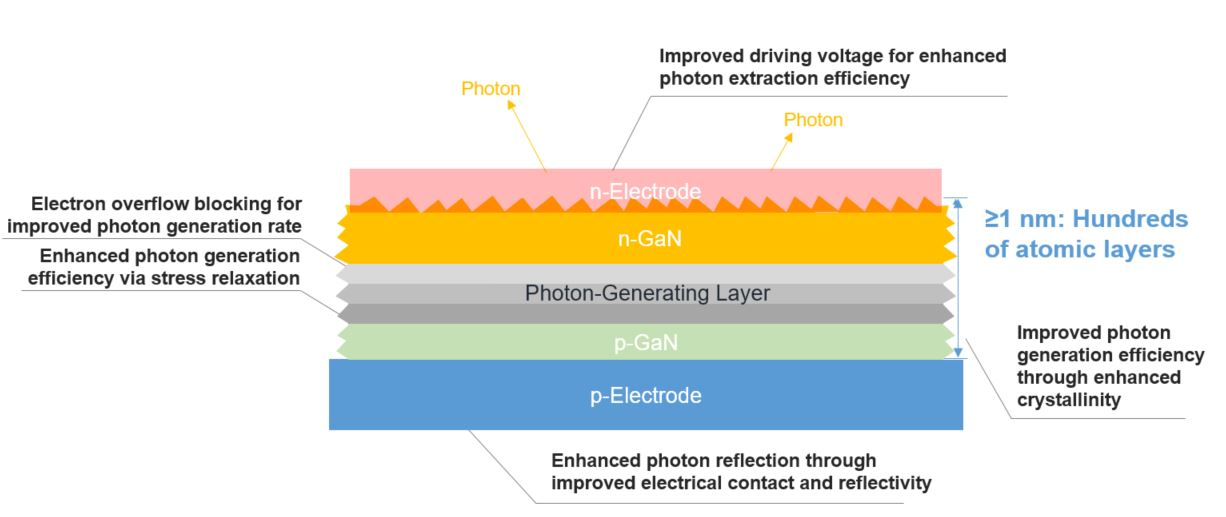
Second, Seoul Viosys’ core competitiveness lies in WICOP, its proprietary technology that eliminates the need for both wires and packaging. This robust structure maximizes light extraction efficiency while enhancing thermal management, enabling high efficiency even at ultra-small scales down to the 1 µm level. Backed by a portfolio of approximately 5,000 opto-semiconductor patents, the company holds a strong advantage in realizing next-generation photonic devices, which well aligns with the market’s shift toward ultra-miniaturization and high integration.
Third, a strong patent barrier is a key competitive advantage. Seoul Viosys, including its subsidiaries, holds approximately 1,800 micro opto-semiconductor patents related to optical communications. Built around these core patents, the company has established a broad and defensible scope of rights, making it extremely difficult for competitors to develop products without infringement. For example, in February, its U.S. subsidiary SETi secured a permanent injunction from a U.S. court against a photonics company with a 40-year history in optoelectronics. Beyond sheer patent volume, the portfolio comprehensively covers core processes, structures, and implementation methods, providing a solid foundation for technological leadership. In addition, its parent company, Seoul Semiconductor, holds an industry-leading portfolio of approximately 15,000 patents in opto-semiconductor packaging and solutions.
Despite years of operating losses, Seoul Viosys has invested tens of millions of dollars annually in Micro LED under its vision of “writing a new history of light,” steadily strengthening its technological competitiveness. The company has collaborated for more than 20 years with a research team at the University of California, Santa Barbara (UCSB), led by Nobel Prize in Physics laureate Shuji Nakamura and Professor Steven DenBaars, and completed development of an ultra-small 1-micrometer (μm)-class device in 2021.
Dr. Dae-Woong Suh, President and Head of R&D at Seoul Viosys, said, “We have built production infrastructure in the United States, Vietnam, and Korea, and are also seeking new partners in India, while strengthening our capabilities in technology collaboration and supply chain response. We are open to working with companies that need our technology, and under strict confidentiality, we will introduce breakthrough products together with our partners.”
According to Grand View Research, the global short-reach optical interconnect market is expected to grow at a compound annual rate of about 20% through 2030, fueled by the expansion of AI infrastructure, to reach approximately $6 billion.
About Seoul Viosys
Seoul Viosys possesses the technological capability to produce full-spectrum opto-semiconductor chips from 200nm to 1,400nm, supported by over 6,000 patents. The company manufactures VCSEL (Vertical Cavity Surface Emitting Laser) and laser diodes, and mass-produces the world’s first “WICOP Pixel,” which integrates R, G, and B for displays into a single chip. Founded in 2002, Seoul Viosys currently holds the world’s No. 1 market share in UV LED. Together with its parent company, Seoul Semiconductor—which holds 15,000 patents—continues to strengthen its technological leadership in the global market. For more information, visit: www.seoulviosys.com.
Contacts
Seoul Viosys
Jinseop Jung
+82-70-4391-8555
jjs8732@seoulsemicon.com